
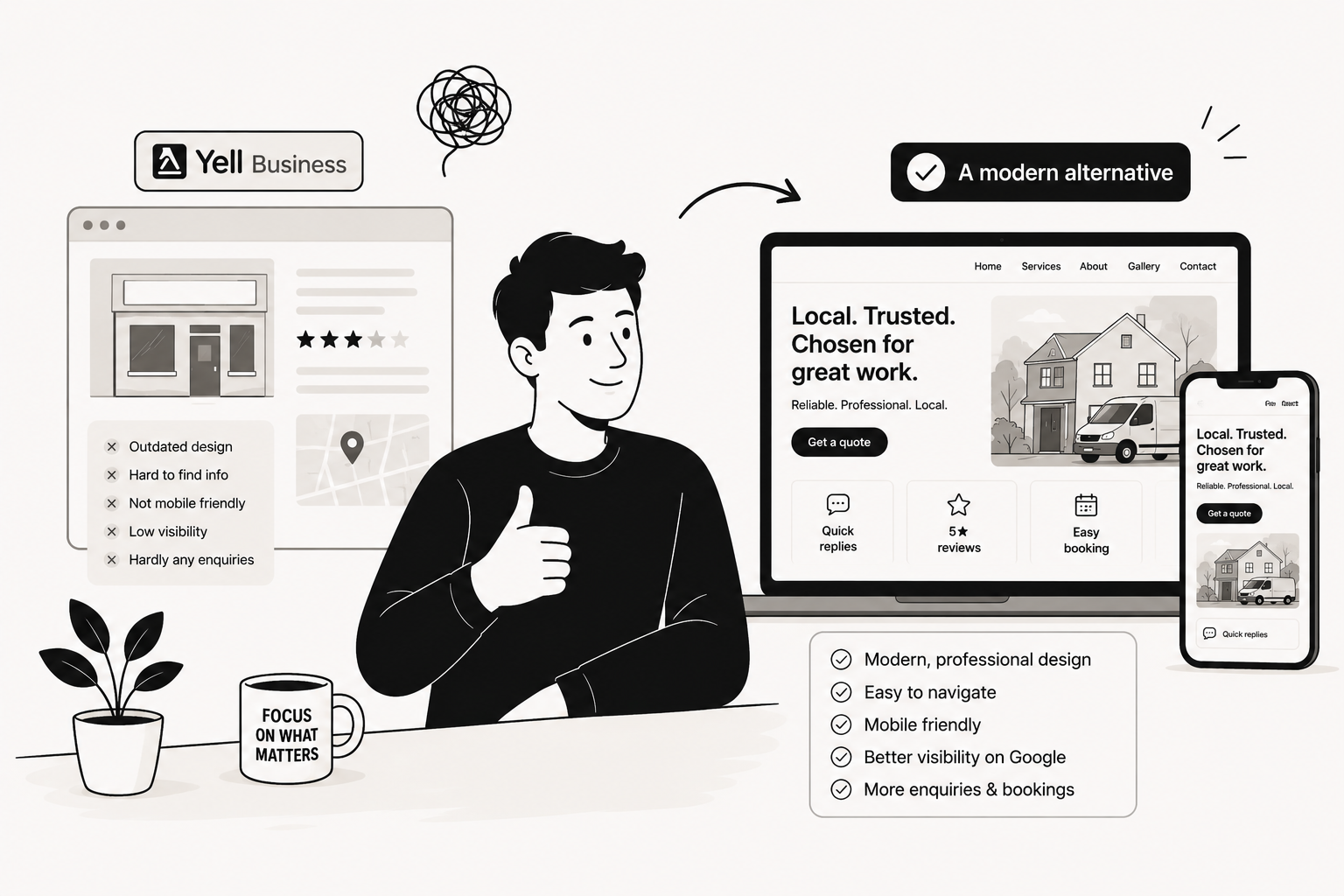
We talk to trades businesses every week who feel locked into Yell contracts and aren't seeing the enquiries they expected. The good news: switching is usually simpler than people fear, and the right setup can pay for itself within a few months.
Why businesses move on from Yell
- Their website looks dated and template-y compared to local competitors.
- They want to make changes themselves without raising a support ticket.
- They're not ranking on Google for the services and towns they work in.
- The monthly fee keeps going up but enquiries don't.
- They want to actually own what they're paying for.
Owning vs renting your online presence
On a Yell package, you're essentially renting. Stop paying and the website goes with it. With a modern setup, the website, hosting, content and analytics all belong to you, you can move providers, hand it to a new agency, or take it in-house whenever you want.
What a modern trades website looks like
- Fast-loading on mobile, under 2 seconds on a 4G connection.
- Clear service pages for each thing you do (e.g. 'Roof repairs in Newcastle').
- Photos of real jobs and your team, not generic stock imagery.
- Visible phone number, WhatsApp button and quote request form on every page.
- Reviews pulled in from Google so visitors trust you straight away.
Local SEO comparison
The single biggest difference between a Yell setup and a modern one is what happens when someone Googles "[your trade] near me". Ranking in those results comes from a combination of:
- A fast, well-structured website with a dedicated page for each service and area.
- A fully optimised Google Business Profile with photos, services and regular posts.
- A steady stream of genuine 5-star reviews from recent customers.
- Consistent business details across all major directories.
Yell touches the last point. Everything else is what we focus on.
Lead generation comparison
- Click-to-call buttons on every page so mobile visitors phone you in one tap.
- Quote forms that ask the right questions for your trade, not just 'name and message'.
- Optional instant-reply text or email so no enquiry sits unanswered.
- Conversion tracking so you know exactly which pages and channels produce work.
What the move actually looks like
- Week 1, discovery, content gathering, photography brief and design direction.
- Week 2–3, build, copywriting for service and area pages, review of every page with you.
- Week 4, launch day: domain pointed across, redirects in place, analytics live.
- After launch, Google Business Profile tightened up, SEO and reporting begin.
Frequently asked questions
Can I keep my domain if I leave Yell?+
Yes, as long as your domain was registered in your own name. If Yell registered it for you, you'll need to request a transfer code (an EPP/auth code) and move it to a registrar you control before you cancel.
Will I lose my Google rankings if I switch website?+
Not if the migration is done properly. Mapping every old URL to its new equivalent with redirects preserves the SEO equity you've built. We do this as standard on every rebuild.
How long does a website migration take?+
For a typical trades business, a full rebuild and migration takes around 2–4 weeks from kickoff to launch. Most of that is content, photography and review work; the technical migration itself happens on launch day.
What happens to my existing reviews and Google Business Profile?+
Your Google Business Profile is owned by you, not Yell, reviews and listings stay with you. We'll help you regain access if needed and tighten up the profile as part of the move.
Honest Yell Business review
Costs, pros, cons and where Yell falls short for trades.
Do you own your website?
Five questions that reveal who really controls your site.
Trades website cost
What a proper trades website should genuinely cost.
Free website audit
We'll review your current setup before you commit to anything.